CONTACT US

Halford Flood Meadow Diary

2025

31 Dec 2025

Last day of the year.

On New Years Eve an invite went out to the Halford Wild Fishermen Club to come and try their luck in the meadow. It was a gloriously sunny and frosty day. A 10:30am breakfast BBQ welcomed them and Christmas guests before fishing began. We were very lucky with the river as it was inbetween floods and was a great level for fishing lures, ledger and float, although it was the float fishing that triumphed with a few big chub on sweetcorn. One of those pictured here, a very healthy 2.5lb River Stour Chub! What a great way to end the year!

by Mike Hopkins

12 Nov 2025

Bumper sloes!

We managed to keep horses on the meadow until early November before the floods came. This enabled us to keep the grass down to a good height over the winter, so that plenty of light could get in early in the spring to encourage the new seeds to grow. One thing that did have a good year in our locality was sloes. We don't have hedges in the meadow, but the photo shows sloes on a blackthorn bush in a hedge in our adjacent field. They provide plenty of food for all sorts of birds in the autumn and winter, and of course, steep them in gin to make sloe gin!

by Mike Hopkins

20 Oct 2025

Dry(ish) and Dramatic.

Putting horses on the meadow for aftermath grazing is always a challenge. Getting the electric fence installed and water infield is just the start! We tend to borrow horses from other places as there is too much grass for our two. They come on holiday to the meadow, they are a mixed bunch, all very smart; some naughtier than others, but they are on holiday, and sometimes get a bit over excited! Daily checks on the fencing are needed and at times repairs are made - sometimes I wonder what goes on in there at night! But everyone goes back a little bit fatter and with different experiences under their belts, a bit like a human holiday in reality!

by Mike Hopkins

24 Sep 2025

Crop Protection

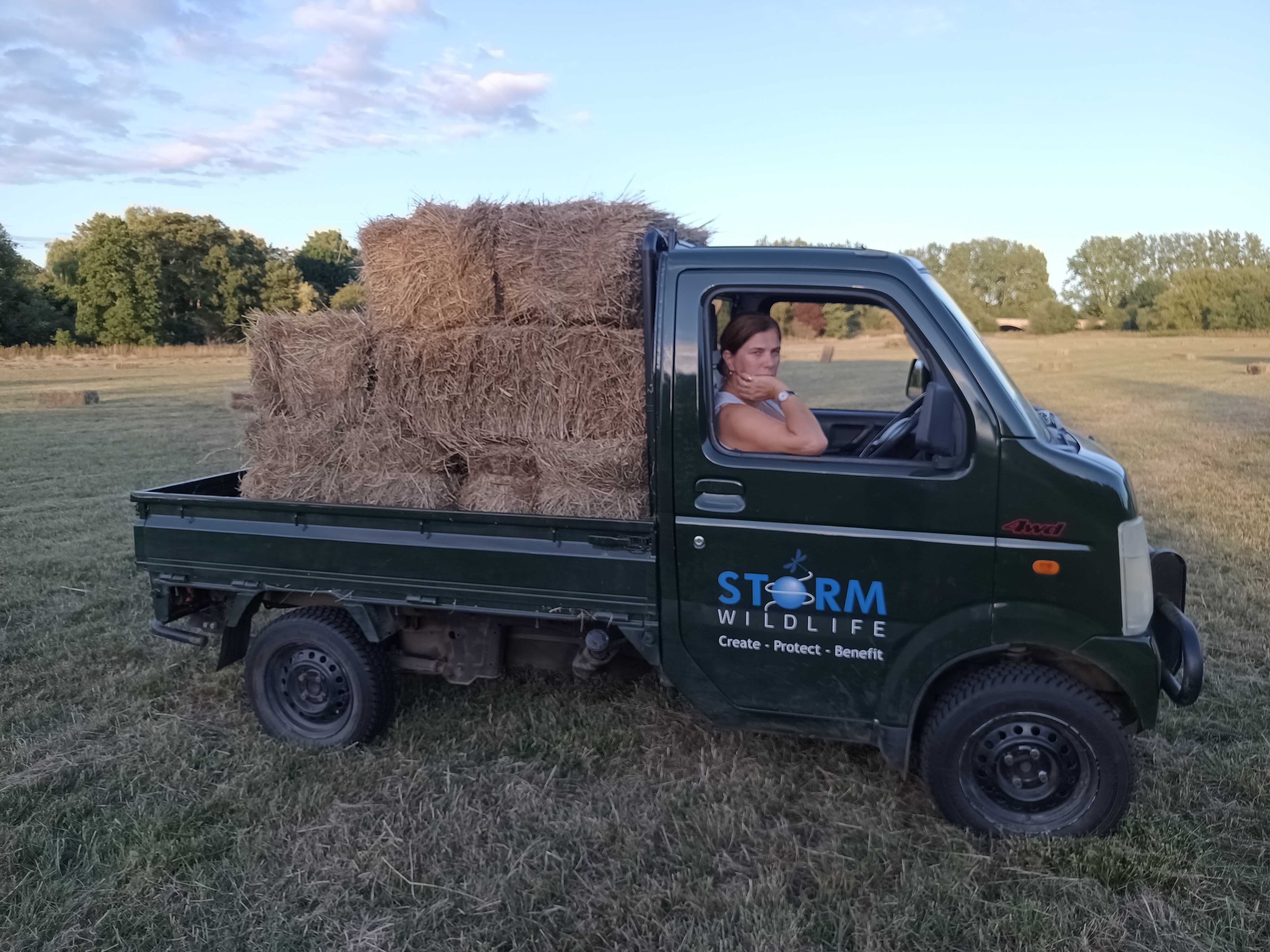
Once the seed is in, every bird in the area seems to want to come and dine on it, if only they could wait a few years they could have an everlasting supply! So we had to call in Sarah the Scarer. She normally welcomes people into the Shipston office of our sister company, Storm Geomatics, but was happy to do a stint on site! She proved reasonably effective if moved around every 10 days.

by Mike Hopkins

8 Sep 2025

We've got it covered!

With an earlier hay cut it has presented us with an opportunity to get the last areas seeded before the floods come. Although we have had early autumn floods before, there is never a right time to sow seed in this meadow, so we are just going for it. We have proof that target species are appearing from sowings that were followed by floods (within two weeks), which has given us more confidence that sowing seed now will have some rate of success. All the seed has arrived from Emorsgate Seeds, an amazing company that produce high quality grass and wildflower seeds for exactly our kind of project - all seed is produced in Cambridgeshire or is harvested from very old established meadows. Now I need to plan some time off from my day job to get the seed sown.

by Mike Hopkins

16 Aug 2025

Hay nonee no!

We did the hay cut this year in the middle of August and because of the dry summer, the yield was significantly down. Last year 52 large round bales were taken, this year we got 9 large round and 100 small rectangular, so the equivilent of about 18 large round. Apparently it was the same pretty much everywhere in the locality. We did small bales this year as they are easier to manage for small scale use like a few horses. The large bales went to the the farmer that made the hay who uses them for his cattle, apparently it was all gone by the middle of September!

by Mike Hopkins

30 Jul 2025

Off with their heads!

Where the meadow was overun with Queen Annes Lace we had to take action to manage the spread of the plant in the coming years. When the flower goes to seed, it produces thousands of small brown seeds per flower head. We spoke to the seed mechant, Emorsgate Seed, about this and they reccomended taking the seed heads off the stalks and taking them away. Difficult when you have about 20,000 plants! In comes the new Storm Wildlife munching machine! Its actually called a flail collector and cuts using flails attached to a rotating drum and collects the arisings in the huge box behind. We found that if you lift the machine on the 3 point linkage of the tractor to the height of the lowest Queene Annes Lace flower head, it makes a good job of whipping them all off and securing them in the sealed box at the back. We took the arisings away and are using them to create compost. You will never get them all, but we have done our best to manage them.

by Mike Hopkins

14 Jul 2025

Too much of a good thing!

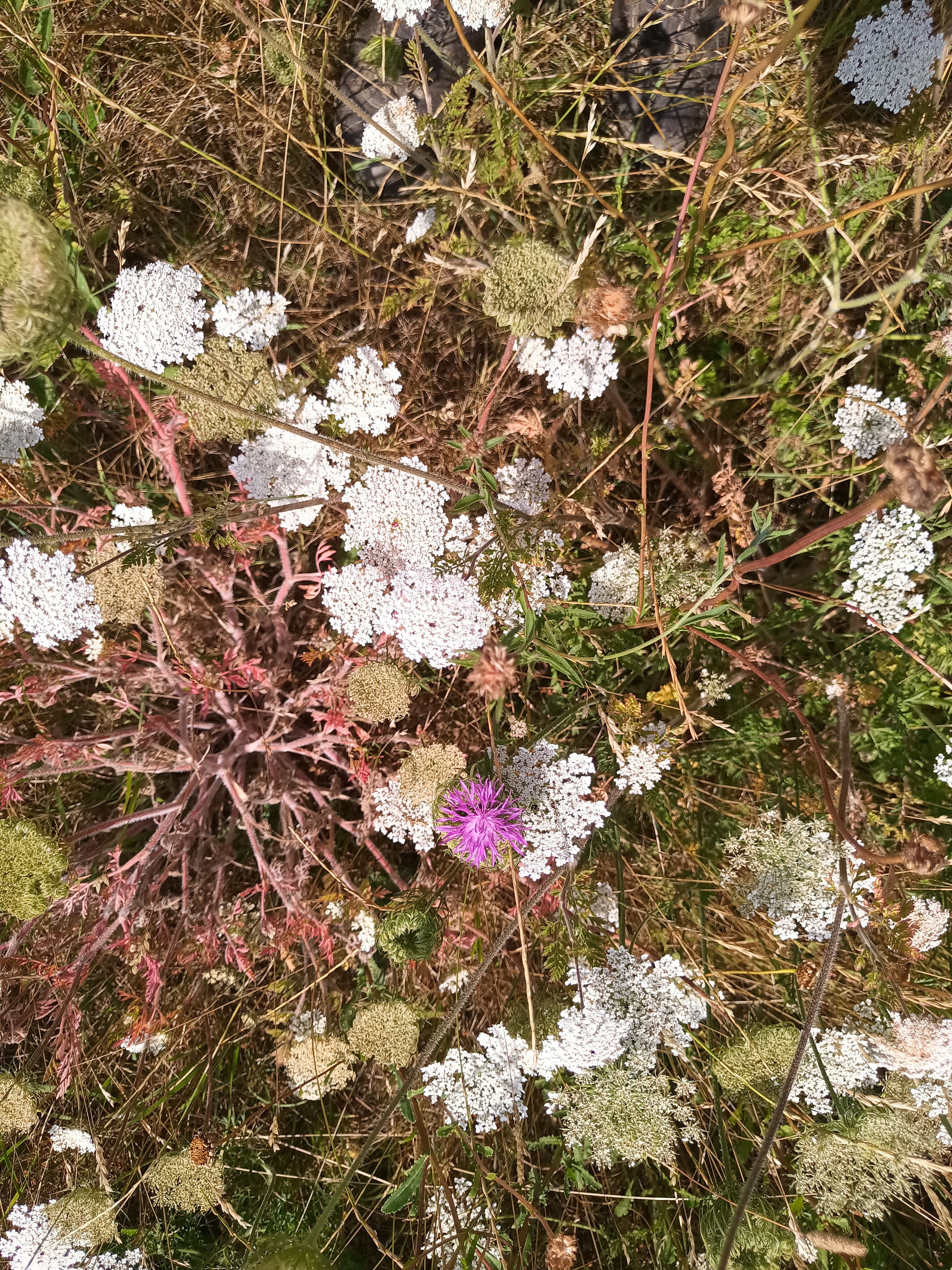
Queen Annes Lace has appeared in abundance and is a great plant for insects like bees as its tiny flowers are a rich source of nectar. Birds eat the seeds and mammals use the big umbrella like canopy to hide under. However, it is so abundant that if it is allowed to seed and is part of the hay cut, we could have even more next year and the year after. Our target is to create a species rich meadow and as you can see from the photo, there is one sole purple flower (common knapweed) amongst the backdrop of Queen Annes Lace.

by Mike Hopkins

2 Jul 2025

Enter the Scythe

The Old English scythe arrived as a Christmas present from my mother-in-law, it had been restored by one of my mother-in-laws farmer friends who had kept it in his barn for many years. I got the scything course from my children for Christmas and this was held in June by a great little company called Hedgecraft. On the course (despite it being for Austrian scythes) I learned how to adjust the scythe for me, cut different types of grasses/undergrowth and how to sharpen the blade. Since learning how to do it properly, I have replaced the petrol strimmer with the scythe for some of the jobs like mowing round the apple trees, it is a lot more satisfying somehow!

We did our annual species count in the meadow using the same What3Words addresses for the nine quadrats. The highest number of species found in one quadrat was nineteen (ten in 2024), with two other quadrats returning seventeen each.  The lowest count of species in a quadrat was five, which is in an area yet to be seeded. An abundance of crested dogs tail grass in the upstream end of the meadow was found which was in the seed mix that was sown in the autumn of 2023, it is beginning to look like the original sowing might come good after all! A marvellous show of Oxeye Daisies, Queen Annes Lace and Common Knapweed coming through for the first time, again all in the seed sown in Autumn 2023. Things are looking up!

by Mike Hopkins

28 May 2025

Bankside vegetation, birds and butterflies.

This is the time of year when it all starts to happen. Pictured is the river between the Oxbow Orchard and the Woods, and this is always a good area for species abundance. Dames Rocket in different colours was very present along the river banks and it is good to see it getting above the abundant nettles early on.

We did a bioacoustic monitoring survey for the entire month of April, this records the sounds in the meadow and goes for analysis to discover the different species of birds that were found, and the frequency they visited. This report is available from our company to anyone that is interested in it. The Chiffchaff was found to be the most recorded bird, with over 9500 calls in the thirty-one days. There were 37 bird species found and the least recorded of those was the House Martin. It was pleasing to hear that the kingfisher was present on 60% of the days in April.

An early butterfly count by Mike Slater from the British Butterfly Conservation Warwickshire Branch revealed an unusually high number of species present in the meadow in April. The species found were: Brimstone, Large White, Small White, Green-veined White, Small Tortoiseshell and Peacock. Later in the month we saw some Orange Tip to bring it up to seven different species for April.

by Mike Hopkins

16 Apr 2025

It's a Golf Course.

Knowing what we know so far, we have taken the plunge and bought a machine that will hopefully prepare our ground better and provide more options for grazing/cutting. We bought an ex-hire flail collector which is often used in parks and golf courses to cut large areas of grass, collect the cuttings in a big collector box and then tip the cuttings into a trailer to take away. It also has scarifying blades which hang beneath the flails and if the mower height is set low enough will scarify the ground, ripping out the rye grass to leave a good amount of bare soil for newly sown seed to make contact with. We used this to sow another 3 acres with Emorsgate 2 seed this month.

by Mike Hopkins

27 Mar 2025

Trees arrive for Oxbow Orchard.

We took delivery of nine heritage fruit trees on 27th March and had them all planted by the end of the month. One was an apple (Court of Wick) to replace the Cox's Permona that we lost in the summer last year. The other eight bare root trees comprised of four pears,a plum, two damsons and a Medlar. Perhaps the most "Warwickshire" tree is the Warwickshire Drooper plum, so called for the trees drooping branches. We established a new orchard in the very distinct Oxbow which is a very tight loop on the river and difficult to mow, therefore it suits an orchard better, so lets see how they like it in there! The trees were supplied by The Heritage Fruit Tree Company and were all a good size and in perfect health. Now to learn how to prune properly!

by Mike Hopkins

28 Feb 2025

First units sold.

We made a sale of biodiversity units last week to enable a developer to start the constuction of a retirement home in the local area. The time taken from the agreement to proceed to the completion of the transaction was exactly one month. This timescale was achieved through efficient communication from all parties.

The funds received will go towards the improvement of the species rich grassland and traditional orchards and the ongoing maintenance.

It has been 3.5 years since we purchased the meadow and started on our journey to be a BNG offset provider - it has been no easy task, but we can now start to see the full cycle of the system working, from management plans to legal agreements to sales and unique transaction codes.

Now the environment will really start to benefit.

Random photo - but I liked it!

by Mike Hopkins

29 Jan 2025

River Behaviour.

To understand nature in completeness is a dream! However, observations and monitoring will provide indications of what to expect. Currently our sister company Storm Geomatics is studying the relationship between the river channel and floodplain using a number of live sensors, strategically placed and amazingly all hooked up to the Internet of Things (IoT). One of of the sensors is a weather station that displays results at the top of this page and updates every 60 seconds! This is an ongoing research project to develop a River Digital Twin® that records river conditions and weather, and will use machine learning to provide detailed river behaviours to help inform flood reduction and nature regeneration projects in the future, not only for Halford Flood Meadow, but all over the UK.

by Mike Hopkins